

Slots without paylines: how cluster pays works
A cluster slot has no paylines. A win comes from a group of identical symbols that touch along their sides, and the bigger the group, the higher the payout. In Babushka's Garden and Gem Quarry clusters start at five symbols. After a payout the cluster usually disappears, the grid refills and the chain can continue. Below: how to read such a grid, how clusters differ from pays for symbols anywhere, what to expect from hit rate, and which three of our games work on this principle.
Key facts
- What pays
- a group of touching identical symbols
- Minimum cluster
- 5 symbols (Babushka's Garden, Gem Quarry)
- Our cluster slots
- Babushka's Garden, Gem Quarry, Parilka
- Grid sizes
- 7x7, 5x5 growing to 7x7, 6x5
- Volatility
- high
- Where to check RTP
- in the game's info panel
Our games in this genre


How cluster payouts are built
Cells count as neighbours if they touch horizontally or vertically. If the grid holds a connected group of five or more identical symbols, it pays according to the paytable: the larger the cluster, the bigger the payout. Diagonals normally do not count, and it is worth confirming this in the rules of each game.
One grid can hold several clusters of different symbols, and all of them pay at once. After the payout the winning cells are cleared, symbols shift down and a chance for the next cluster opens. That is why cluster slots almost always come with cascades: for the second mechanic, see the page on cascade slots.
Clusters versus pays anywhere
The two formats are often confused. In a cluster game the symbols must touch. In a pays-anywhere game only the total count matters: Storm Titan Kaelos, for example, pays for eight or more matching symbols anywhere on its 6x5 grid, touching or not. The difference for a newcomer is simple: in a cluster, look at adjacency; in pays anywhere, just count.
Hit rate and volatility
The bonus slots in our lobby are high volatility. A typical hit rate is 18-26% of spins, so roughly three spins in four pass without a payout. A cluster win is often small: five symbols pay little, and the big sums come from long chains, multipliers and the bonus.
That is neither a bad nor a good mechanic, just a particular rhythm: long without a payout, then a burst. If the rhythm does not suit you, pick a smaller stake or other games. The spread of results is covered in the piece on volatility.
Our cluster slots
Babushka's Garden: a large 7x7 grid where clusters of five or more pay and matryoshka wilds carry multipliers.
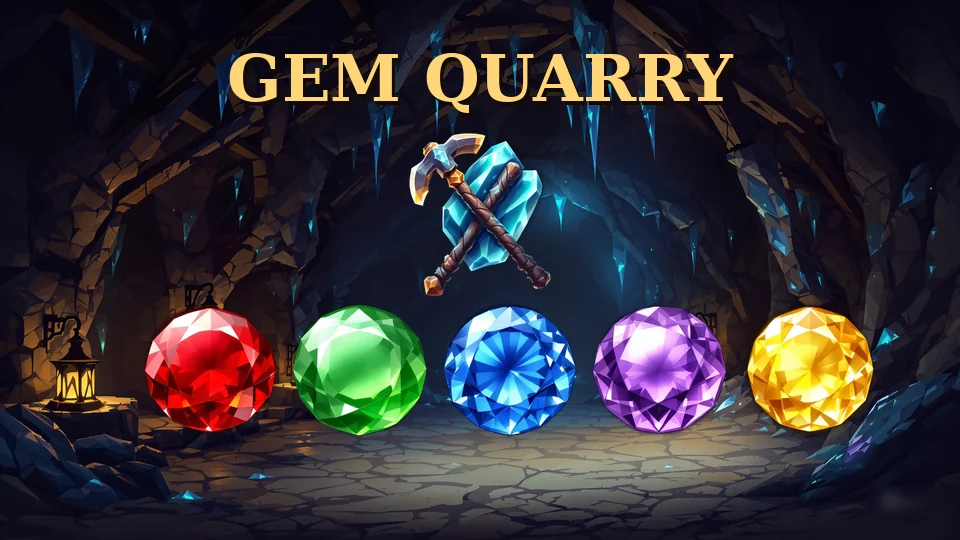
Gem Quarry: the quarry starts as a 5x5 grid and opens up to 7x7 as you play. Clusters again start at five symbols, and chalk marks on cells double.
Parilka: a 6x5 grid with cluster pays, tumbles and a heat ladder of multipliers from x1 to x16. The higher the rung on the ladder, the larger the multiplier.
What to look at in the info panel
A newcomer can find these in the rules within a minute:
- The minimum cluster size and the paytable by size.
- How multipliers behave: whether they grow along the chain, persist or reset.
- Theoretical RTP and Max win per round: the RTP guide explains how to read these figures.
- Whether a bonus buy exists and its price: see the page on bonus buy slots.
The role of multipliers
In cluster games a multiplier decides whether an ordinary payout becomes a noticeable one. Matryoshka wilds, chalk doubling and the heat ladder are different ways of doing it. How multipliers work across the genre is covered on the page about multiplier slots.
Remember that a multiplier multiplies only a payout. If the chain had no win, there is nothing to multiply, so a big multiplier on an empty grid brings nothing.
How to approach the game
Open the game in demo: a guest plays demo only, on a $10,000 balance, which is a good way to feel cluster size and chain speed. For real play choose a stake that survives long runs without payouts. The bet ladder starts at $0.05 and the maximum in slots is up to $100.
No betting pattern changes the maths. The game is for players aged 18 and over.
Frequently asked questions
What is cluster pays?
A payout format without paylines where a win comes from a group of identical symbols that touch horizontally or vertically. In Babushka's Garden and Gem Quarry the minimum cluster is five symbols, and the size of the group sets the payout.
How is a cluster slot different from a regular one?
A regular slot pays along lines or left-to-right combinations. A cluster slot needs a group of neighbouring symbols anywhere on the grid. There are no paylines, so there are no line numbers either.
Which of your slots are cluster slots?
Babushka's Garden (7x7 grid), Gem Quarry (5x5 growing to 7x7) and Parilka (6x5 grid). In the first two, clusters start at five symbols, and in all three multipliers and cascades build the main wins.
Do cluster slots win often?
In our bonus slots winning spins are typically 18-26%. Small clusters pay modestly, so a spin can be a win without covering the stake. Large sums come from chains and the bonus.
Is there a winning strategy for cluster games?
No. The server's generator decides each spin and betting patterns do not change the maths. You can only manage stake size and playing time so that spending stays within your budget.
Read next
Updated: 2026-11-04. 18+. Gambling can be addictive: stake only what you can afford to lose.